
- Call Us: (+92) 315 602 7970
- Email: info@ilajbilquran.com
In this article
Introduction
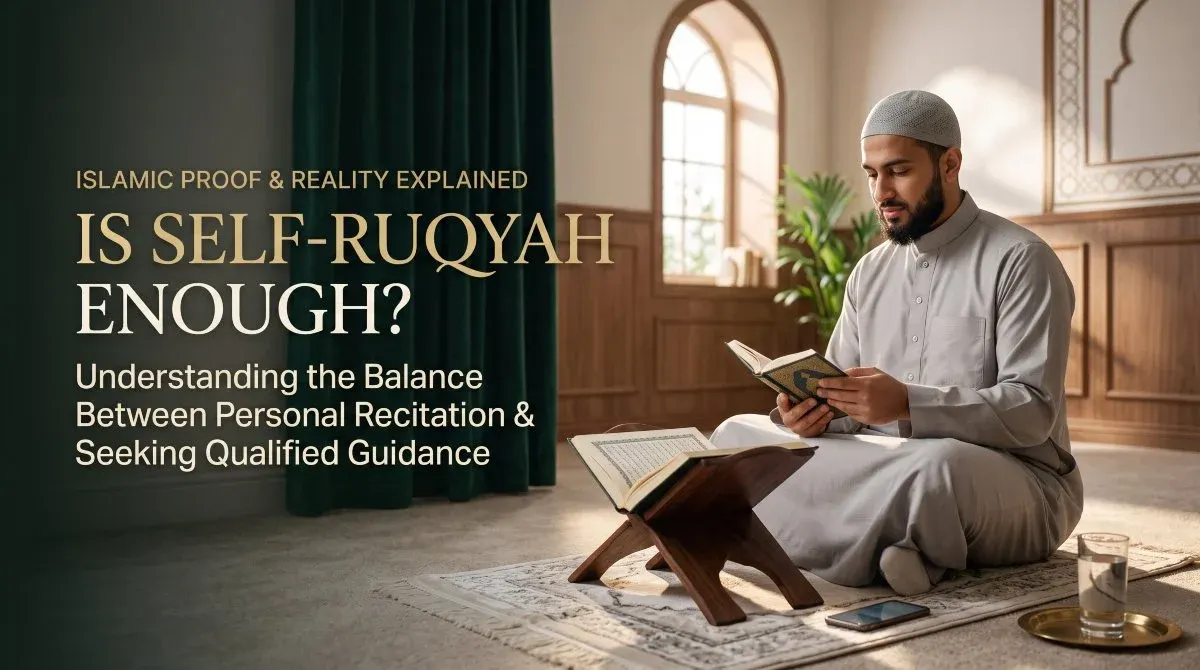
In recent years, many people have promoted the idea that self ruqyah alone is enough, and that seeking ruqyah from another person is unnecessary or even discouraged. This belief is often built on one misunderstood hadith, while ignoring many other authentic narrations, scholarly explanations, and clear logical realities.
This article addresses the issue honestly, using Islamic evidence, sound reasoning, and real-life analogy, to clarify why self ruqyah alone often fails in serious spiritual illnesses.
A Simple Logical Reality People Ignore
Let us start with something everyone understands.
If a person develops a high fever, can he:
Insert an IV drip into himself?
Administer injections correctly to himself?
Monitor complications accurately?
The answer is obvious: no.
Even more important:
If a medical specialist or consultant, someone who knows:
The composition of IV fluids
Dosages of injections
Treatment protocols
Becomes seriously ill, what does he do?
He does not treat himself.
He goes to the hospital and allows another doctor to treat him.
If this is the case with physical illness, then ask yourself honestly:
👉 How can a person suffering from spiritual illness be expected to fully treat himself, when the illness itself:
Weakens focus
Creates laziness
Causes doubt and resistance
Affects emotions and discipline
This is not wisdom.
This is self-deception.
Self Ruqyah Is Dhikr, Not Always Treatment
Allah describes the Quran as a source of healing and mercy for believers.
Here is a critical distinction many people fail to understand.
When you recite Quran over yourself:
It is dhikr
It is worship
It is protection
It is rewarded by Allah
Just like morning and evening adhkar.
But when another person recites Quran over you with intention of treatment, it becomes:
Ruqyah
Diagnosis
Targeted healing
The same Quran.
Different application.
Confusing dhikr with treatment is a fundamental mistake.
This clearly shows why the importance of Ruqyah in a Muslim’s life goes beyond simple self recitation and requires proper understanding and practice.
The Danger of Building a Ruling on One Hadith
Many people misuse the hadith of the seventy thousand who will enter Paradise without reckoning:
“They are those who do not ask for ruqyah…”
(Sahih al-Bukhari and Muslim)
This hadith does not prohibit ruqyah, nor does it condemn those who receive it.
Islamic scholars clearly explained:
This is about higher virtue, not obligation
It does not apply in cases of necessity
It does not forbid receiving ruqyah
Fatwa of Shaykh Ibn Baz رحمه الله
Shaykh Ibn Baz explicitly stated that:
Receiving ruqyah is permissible
There is no sin or blame
The hadith does not include cases of need or harm
The Prophet ﷺ himself accepted ruqyah
🔹 Using one hadith to stop people from treatment while ignoring dozens of others is not fiqh, it is ignorance.
True fiqh requires:
Collecting all evidences
Understanding context
Reconciling texts
Issuing balanced rulings
Not cherry-picking.
The Prophet ﷺ Accepted and Performed Ruqyah
The Sunnah is crystal clear.
Aisha رضي الله عنها said:
“When the Prophet ﷺ became severely ill, I recited ruqyah over him.”
(Bukhari and Muslim)
If receiving ruqyah was weakness or blameworthy:
The Prophet ﷺ would not have accepted it
The companions would not have practiced it
Scholars would not have permitted it
Reality contradicts the claim.
Spiritual Illness Is Increasing, Not Decreasing
Another truth people refuse to face:
👉 Shaytanic strength increases with neglect and time.
As sins spread:
Magic increases
Envy increases
Weak faith increases
Spiritual ignorance increases
This results in:
More severe cases
More complex symptoms
More resistance to self effort
Treating modern spiritual illness with casual self ruqyah is like treating cancer with painkillers.
Why Self Ruqyah Often Fails in Serious Cases
Many people fail in treatment because they stop early and ignore the essential principles that lead to successful Ruqyah treatment.
Because the patient:
Is inside the problem
Cannot observe patterns
Cannot diagnose objectively
Is emotionally compromised
Is spiritually attacked
Treatment requires:
External strength
Consistency
Supervision
Correction
Persistence
This is how ruqyah was practiced historically.
The Balanced Islamic Path
Islam does not teach:
Blind reliance on others
Nor arrogant self-sufficiency
Islam teaches:
Worship Allah
Make dhikr
Seek treatment
Use correct means
Persist until cure
Final Clarification for the Reader
O reader,
If you recite Quran yourself:
You are worshiping
You are protecting yourself
You are rewarded
But if another recites over you:
You are receiving treatment
You are confronting the illness
You are addressing the root cause
Do not confuse the two.
Conclusion
Self ruqyah is beneficial.
But beneficial does not mean sufficient.
Serious illness requires serious treatment.
Islam is a religion of wisdom, balance, and knowledge, not slogans built on one misunderstood narration.
© Copyright 2026, All Rights Reserved
Leave Your Comments